01 Residuality Theory
Barry created his own approach to designing systems.
Residuality Theory grew out of one simple observation:
we design systems for a world we can never fully predict.
Barry combined ideas from complexity science with the practice of software architecture, creating a way of thinking and a set of techniques for analysing how a system may behave under change and previously unknown stressors.
It isn’t just another framework to add to your toolbox.
Residuality Theory offers a different way of looking at the problem of architecture design itself - especially when a system operates in a complex, unpredictable environment.
02 Research and publications
A theory Barry has been developing for years.
Residuality Theory isn’t a one-off publication. Barry’s research covers:
- residual analysis
- stressor analysis
- complexity
- hyperliminal coupling
- using simulation and matrices to make architecture decisions
His papers on Residuality Theory have been published by Cutter Consortium and in Procedia Computer Science.
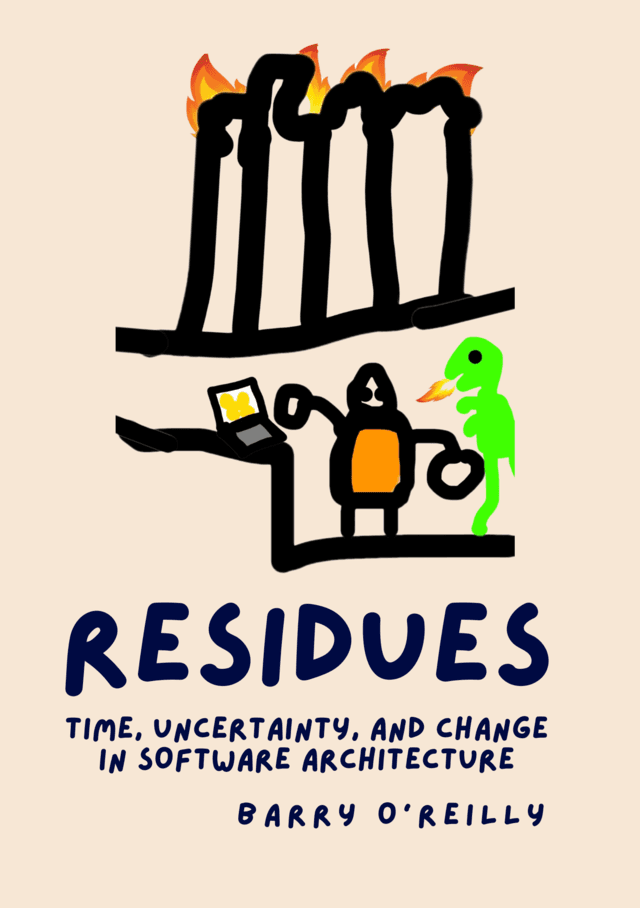
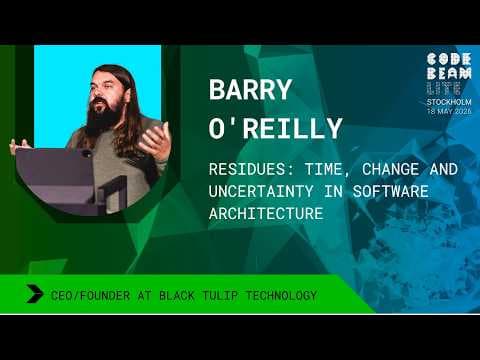
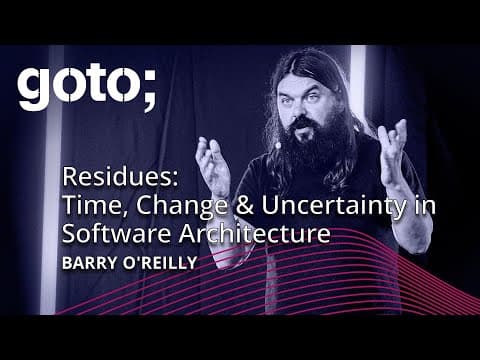
Residues: Time, Change and Uncertainty in Software Architecture
An accessible introduction to Residuality Theory and how to apply it in software architecture. Barry describes it as a shorter, more approachable version of the ideas he had developed earlier in his papers and talks.
View on Leanpub03 Workshops and talks
He doesn’t just write about architecture. He teaches it live.
Barry runs workshops on Residuality Theory and software architecture at international events for architects and engineers. He has spoken and taught at, among others:
- GOTO Copenhagen
- iSAQB Software Architecture Gathering
- NDC
- Virtual DDD
- Cutter Consortium
Two-day masterclass
In 2026, at GOTO Copenhagen, he ran the two-day masterclass Advanced Software Architecture with Residuality, titled Designing resilient software for complex domains.
Full-day workshop
At the iSAQB Software Architecture Gathering he also ran a full-day workshop on Residuality Theory, covering stressor analysis, working with residues, unknown unknowns and component decisions.
04 His starting point is simple
In the traditional approach, many architecture decisions rest on requirements, assumptions and risk forecasts. Barry asks a different question:
What happens to the system when something happens that we didn’t foresee?
That question leads to analysing stressors, dependencies and what remains of the system after they hit - and that is what Residuality Theory is built around.
05 The workshop
Why learn this from Barry?
Because you’re not learning Residuality Theory second-hand.
You work with its creator.
Barry will show you not only the principles of the theory, but also how he uses it to think about architecture under uncertainty.
During the workshop you’ll work with practical techniques, including stressor analysis, modelling residues and dependency analysis, and then apply them to a real architecture.